What Is an Advantage to Using aã¢â‚¬â€¹ Stem-and-leaf Plot Instead of a Histogram to Displayã¢â‚¬â€¹ Data?
Descriptive Statistics > Stemplot / Stem and Leaf Plot
What is a Stemplot?
A stemplot is similar a histogram — they are both tools to help y'all visualize a information gear up. Stemplots show a little more than data than a histogram and have been a common tool for displaying data sets since the 1970s. They are typically used when at that place is a medium amount of quantitative variables to clarify; Stemplots of more than than 50 observations are unusual. The name "Stalk plot" comes because there is i "stem" with the largest place-value digits to the left (shaded in gray in the image below) and ane "leafage" to the correct.
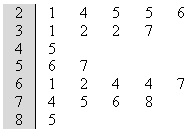
The start few values from this stemplot are:

21 24 25 25 26 (the first line).
31 32 32 37 (the 2nd line)
What are Stemplots used For?
A stem and foliage plot is a way to plot information where the data is split up into stems (the largest digit) and leaves (the smallest digits). They were widely used before the advent of the personal computer, as they were a fast way to sketch data distributions by hand. They are used less frequently today, but y'all'll still encounter some here and there.
The stem and leaf plot is used similar a histogram; it allows you to compare data. While a histogram uses confined to represent amounts, the leaves of the stemplot represent amounts. A very long foliage means that "stem" has a large amount of information. The stems with the largest corporeality of data in the moving picture above are the 2 and half-dozen stems.
The numbers are arranged past place value. The largest place-value digits are placed in the stalk. Stemplots in the existent world aren't usually labeled with the place-values that the stem represents — information technology'southward usually up to you to effigy it out based on the context and the data. However, in textbooks and other education materials it's common for stemplots to be labeled. For example, a key next to the following stemplot tells you lot that vii|5 means 75, indicating that the stem represents tens and the leafage represents units.
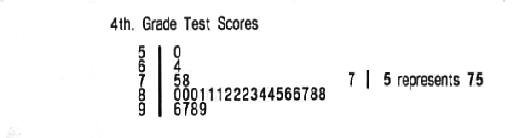
Stem values are listed downwardly (ascending society, from smallest to largest) and the leafage values are listed correct to left (ascending order, from smallest to largest).
Advantages
Stem and leaf plots are useful in some cases because you tin can come across where the bulk of scores lie. In the higher up graph, most scores were in the 20s or 60s. Bar graphs also show this information, but the advantage the stalk and foliage plot have is that you can see all of the scores (other charts usually show just totals). These types of charts requite y'all a quick overview of a distribution and you tin also see the shape of the distribution (think of each leaf as representing a bar on a bar chart). They are likewise useful for highlighting the manner (the most common number in a data set) and for finding outliers.
Disadvantages
A disadvantage of stem and leafage plots is they are actually only useful for modest data sets from about 15 to 150 data points. Dot plots are normally more useful for smaller information sets, and for larger data sets a box plot or histogram is used.
Back-to-Back Stemplots
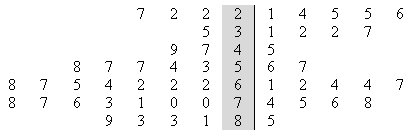
Back to back stemplots have two leaves that share a single stem. The stem on the back-to-back stemplot is shaded gray in the following flick.
What does it mean to Trim the Leaves on a Stemplot?
Trim the leaves means to become rid of unnecessary digits in your data. Permit'southward say you were plotting the following numbers on a stemplot:
141 162 112 153 137 106 103 82 151
For these numbers you would want the stalk to be the hundreds place digit and the leaves the tens place. That makes the units unnecessary, then trim (circular) them to get:
140 160 110 150 130 100 100 eighty 150
What Does information technology Hateful to Split up the Stalk on a Stemplot?
Let'due south say you have this prepare of data that you desire to brand a stemplot for:
140 160 110 150 130 100 100 80 150
170 200 170 100 170 360 150 150 260
The stems in this stemplot would be the hundreds digits (0,ane,two,three). That would requite you a very small stemplot with simply four stems.
0
1
ii
3
Ideally, you desire betwixt six and 20 stems on a stemplot. We just have iv, then split the stems into two to become eight stems. The first part of the split stem you can use for 0-49 and the 2nd part of the stem for fifty-99. Here'southward how the numbers 140 160 110 150 and 130 would be entered into this stemplot:
0
0
i | 4 1 3
1 | six 5
2
2
3
iii
How to Make a Stemplot
Stemplots are fabricated up of a stalk (usually the highest place value digit) and "leaves", which are the digits or units. For example, a simple stemplot of x,21 and 32 would have tens as the highest gild digits and 0,1, and 2 as the leaves. Call back of a stemplot as being a histogram or bar chart fabricated from actual numbers instead of blocks.
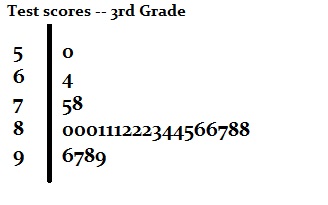
Example Question: Make a stemplot from the following data set, which represents tertiary grade exam scores: 64, 82, 85, 99, 96, 81, 97, eighty, 81, 80, 84, 87, 98, 75, 86, 88, 82, 78, 81, 86, 80, 50, 84, 88, 83, 82.
Pace ane: Place the numbers in society from smallest to largest: l, 64, 75, 78, 80, eighty, fourscore, 81, 81, 81, 82, 82, 82, 83, 84, 84, 85, 86, 86, 87, 88, 88, 96, 97, 98, 99.
Step 2: Choose your stem. By and large, the stem will exist the largest place value. For this data gear up, the largest place value is x, then the stalk for this sample question will stand for the tens units.
Footstep 3: Carve up your ordered numbers (from Step 1) into groups based on the identify value y'all chose in Step 2. For this sample question we chose tens as the place value so the groups are:
fifty
64
75, 78
80, fourscore, 80, 81, 81, 81, 82, 82, 82, 83, 84, 84, 85, 86, 86, 87, 88, 88
96, 97, 98, 99.
Although not strictly necessary, this step makes it easier to visualize the stem-and-leaf plot coming together.
Step iv: Draw an outline of your graph. All that's really needed to make a simple stemplot is a vertical line:
Step 5: Draw the stem numbers. For this sample problem, the stem represents tens. The scores range from 50 to 99 then the tens are 5,vi,seven,eight, and 9.
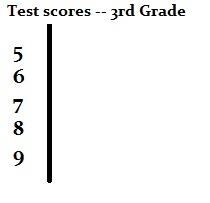
Step six: Draw the foliage digits based on the groupings from Footstep 3. Hither are the leaf digits bolded, along with the finished stemplot:
v0
64
seven5, 78
80, 80, 80, 81, 8ane, 8one, 82, 8ii, eightii, 83, 84, 84, viiifive, 86, 86, 8vii, 88, 88
ix6, 97, ix8, 99
That's how to make a stemplot, the easy mode!
References
Moore, D. & Notz, W. (2019). Statistics: Concepts and Controversies. W. H. Freeman.
---------------------------------------------------------------------------
Need help with a homework or test question? With Chegg Study, you can get step-by-step solutions to your questions from an expert in the field. Your outset 30 minutes with a Chegg tutor is free!
Comments? Need to post a correction? Delight post a annotate on our Facebook page .
Source: https://www.statisticshowto.com/stemplot/
0 Response to "What Is an Advantage to Using aã¢â‚¬â€¹ Stem-and-leaf Plot Instead of a Histogram to Displayã¢â‚¬â€¹ Data?"
Post a Comment